1. What is Ping Post Lead Distribution?
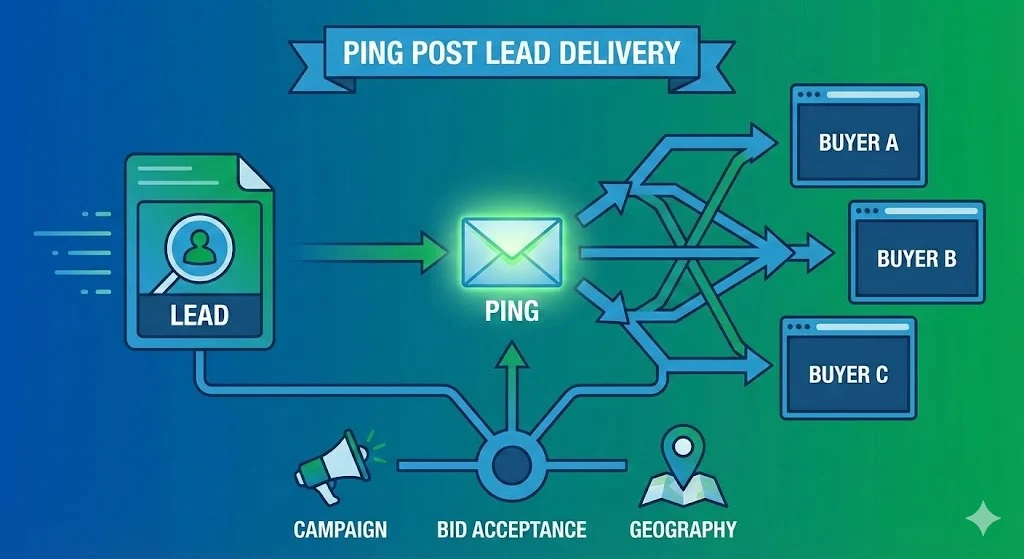
Ping post lead distribution is a real-time, two-step system for buying and selling consumer leads. Instead of sending a lead's complete contact details to a single buyer upfront, the system first sends a partial, anonymous data packet — the ping — to a pool of potential buyers. Interested buyers respond with a bid or acceptance. Only then does the system send the full consumer profile — the post — to the winning buyer.
This creates a competitive, auction-style marketplace for every lead, which drives up revenue for sellers while ensuring buyers only pay for leads that meet their specific targeting criteria. It is the dominant model in performance-based lead generation because it aligns incentives perfectly: sellers are rewarded for volume and quality, while buyers control exactly what they purchase.
Simple definition: Ping post is a two-round lead handoff. Round one (the ping) asks "does anyone want this lead?" Round two (the post) says "here's everything — you won."
The concept emerged from the insurance and mortgage industries in the early 2000s but has since spread to virtually every sector where multiple buyers compete for the same type of consumer inquiry — solar, legal, auto finance, home improvement, and more.
2. How Does the Ping Post Process Work?
The full ping post cycle completes in under five seconds. Here is each step in detail:
Consumer Submits a Form
A consumer fills out a lead generation form — requesting an insurance quote, a mortgage rate, a solar estimate, etc. — on a publisher's website or landing page.
Publisher Sends the Ping
The lead generation platform strips personal identifiers and broadcasts an anonymous ping — age range, ZIP code, product interest, credit range — to a configured list of lead buyers simultaneously.
Buyers Respond with Bids or Acceptance
Each buyer's system evaluates the ping against its own filters (geographic caps, income range, lead caps, etc.). Qualified buyers respond in milliseconds with an acceptance or a dollar bid.
System Selects the Winner
The platform selects the highest bidder (or highest-priority buyer in a non-auction setup) and records the transaction, including agreed price and buyer identity.
Full Lead Posted to the Winner
The complete consumer record — name, phone, email, and all form responses — is immediately delivered to the winning buyer via API, CRM webhook, or direct database entry.
Buyer Contacts the Consumer
The sales team or automated dialer contacts the consumer within seconds of submission — while interest is highest — dramatically improving conversion rates.
3. The Ping vs. The Post — What's in Each?
Understanding exactly what data travels in each stage helps both buyers and sellers configure their systems correctly and stay compliant with privacy regulations like TCPA and FCC one-to-one consent rules.
| Data Field | In the Ping? | In the Post? | Purpose |
|---|---|---|---|
| ZIP / State | ✔ Yes | ✔ Yes | Geographic targeting filter |
| Age Range (e.g. 25–34) | ✔ Yes | ✔ Yes | Demographic fit |
| Product Interest | ✔ Yes | ✔ Yes | Vertical/category match |
| Credit Tier (broad) | ✔ Yes | ✔ Yes | Pre-qualify buyers |
| Homeowner Status | ✔ Yes | ✔ Yes | Eligibility check |
| Full Name | ✘ No | ✔ Yes | Contact identification |
| Phone Number | ✘ No | ✔ Yes | Outreach |
| Email Address | ✘ No | ✔ Yes | Email nurture |
| Exact DOB | ✘ No | ✔ Yes | Compliance / underwriting |
| Specific Income | ✘ No | ✔ Yes | Detailed qualification |
| Consent Certificate | ✘ No | ✔ Yes | TCPA compliance proof |
| Bid / Accepted Price | ✔ Yes | ✔ Yes | Revenue attribution |
Privacy note: Keeping PII (personally identifiable information) out of the ping is not just best practice — it is increasingly a regulatory requirement. Ping Tree Systems automatically separates PII and routes consent certificates with every post. See our guide on FCC one-to-one consent.
4. What is a Ping Tree?
A ping tree is the routing logic layer that governs how pings are distributed. Rather than blasting every buyer at once, a ping tree sends pings sequentially or simultaneously through a hierarchy of prioritized buyers — sometimes called tiers.
How a Ping Tree Is Structured
Tier 1 buyers get first right of refusal. They typically pay the highest price and have the strictest acceptance filters. If a Tier 1 buyer rejects or times out (usually within 1–3 seconds), the ping drops to Tier 2, then Tier 3, and so on — ensuring every lead finds a home even if the premium buyers pass.
Key Ping Tree Parameters
Bid Floor & Ceiling
Sellers set minimum acceptable bid prices per lead type or vertical to protect revenue.
Filter Criteria
Buyers specify which leads qualify — by state, age, product type, income, homeowner status, and more.
Timeout Rules
Each tier has a response-time window. Slow or non-responding buyers are automatically skipped to keep the cycle under 5 seconds.
Lead Caps
Buyers can set daily, weekly, or monthly caps to control volume and budget without manual intervention.
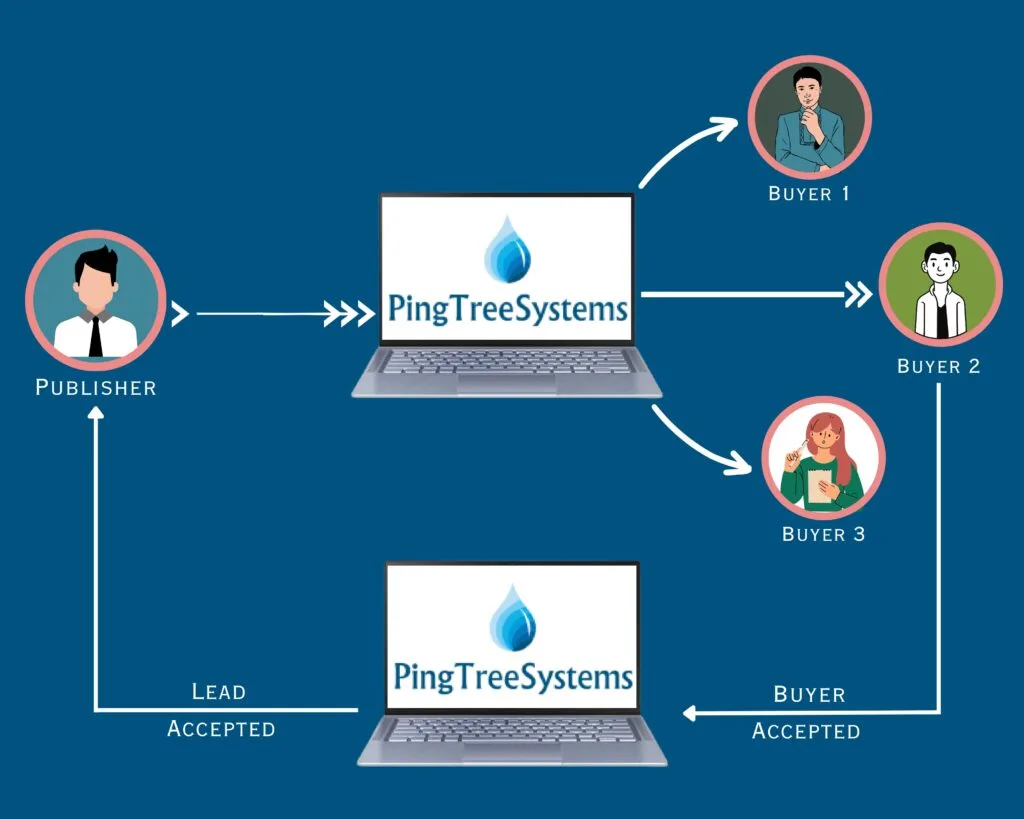
Ping Tree Systems' platform gives sellers and buyers a visual drag-and-drop interface to configure their ping tree — including tier priority, bid thresholds, geographic restrictions, and acceptance rules — without writing a single line of code. Learn more on our Ping Post Lead Distribution product page.
5. Ping Post vs. Direct Post — Comparison Chart
If you are new to lead distribution, you may encounter both ping post and direct post models. Here is a definitive side-by-side comparison to help you decide which is right for your operation.
| Feature / Factor | Ping Post | Direct Post | Winner |
|---|---|---|---|
| Lead Delivery Speed | Real-time (<5 seconds) | Real-time (instant) | Both |
| Buyer Competition | Multiple buyers bid simultaneously | Single predetermined buyer | Ping Post |
| Revenue per Lead (Seller) | Higher — auction drives prices up | Lower — fixed negotiated price | Ping Post |
| Lead Quality (Buyer) | Higher — buyer sets exact filters | Variable — based on batch agreement | Ping Post |
| Data Privacy in Transit | PII protected at ping stage | Full PII sent immediately | Ping Post |
| Setup Complexity | Moderate (ping tree configuration) | Simple (one destination endpoint) | Direct Post |
| Exclusive Lead Option | ✔ Yes (exclusive post) | ✔ Yes (by default) | Both |
| Multi-Buyer Option | ✔ Yes (shared leads) | ✘ No | Ping Post |
| Return / Rejection Rate | Lower — buyer pre-approved the lead | Higher — no pre-qualification step | Ping Post |
| ROI Transparency | High — every lead has an audit trail | Moderate — batch attribution | Ping Post |
| TCPA / Consent Handling | Consent certificate in post payload | Depends on publisher workflow | Ping Post |
| Best For | Multi-buyer networks, premium verticals | Direct publisher–buyer relationships | — |
For a deeper dive, see our blog: What is the Difference Between Ping Post and Direct Post?
6. Benefits for Lead Buyers & Sellers
For Lead Sellers (Publishers / Generators)
Maximized Revenue
Competitive bidding ensures every lead earns its true market value — no more leaving money on the table with fixed rates.
Real-Time Reporting
Dashboard visibility into accepted vs. rejected pings, revenue per lead, and buyer performance — all in real time.
Multiple Buyer Connections
One integration point connects you to an entire network of buyers instead of building separate integrations for each.
Zero Unsold Leads
Tiered ping trees ensure every qualifying lead finds a buyer — reducing waste and improving overall campaign efficiency.
For Lead Buyers
Precision Targeting
Set exact geographic, demographic, and behavioral filters — pay only for leads you have pre-approved at the ping stage.
Speed-to-Contact
Receive leads within seconds of the consumer's form submission, dramatically improving contact and conversion rates.
Lower Return Rates
Because you pre-screen via ping before purchasing, you receive fewer non-qualifying leads and dispute fewer charges.
Compliance Built In
Consent certificates and DNC checks travel with every post, reducing TCPA exposure for your sales team.
7. Industries That Rely on Ping Post Lead Distribution
Ping post has become the default infrastructure for any high-competition vertical where consumer inquiries are valuable and speed-to-contact is critical. These are the industries that benefit most:
Each vertical has its own buyer ecosystem, bidding norms, and compliance requirements. Ping Tree Systems supports all of the above with vertical-specific templates, consent management, and pre-built CRM integrations.
8. Key Statistics
Data consistently shows why ping post has taken over from older lead distribution models:
These numbers underscore why every serious lead buyer and seller in 2026 needs a robust ping post infrastructure. Speed and targeting are not optional advantages — they are competitive necessities.
9. Choosing Ping Post Lead Distribution Software
Not all ping post platforms are created equal. Here are the critical features to evaluate when selecting a lead distribution system for your business:
Real-Time Bidding Engine
The platform must process pings and return bid responses in under 500 milliseconds to stay within acceptable latency windows for buyers.
Flexible Filter Builder
Buyers need granular control: state, county, lead type, age, credit score range, homeowner status, and custom fields specific to your vertical.
Compliance & Consent Management
Look for TrustedForm or similar certificate integration, DNC scrubbing, and built-in TCPA consent tracking attached to every post payload.
CRM & Dialer Integrations
The winning post should flow directly into your CRM (Salesforce, HubSpot, Zoho, GoHighLevel) or dialer (PhoneBurner, CallHub) without manual steps.
Detailed Analytics & Reporting
Track accepted/rejected pings, revenue per lead, buyer performance, ROI by source, and compliance flags — all from a single dashboard.
Scalable Pricing
Look for transparent pricing that scales with volume. Ping Tree Systems offers full setup for under $300/month, making it viable for small and large operations alike.

Ping Tree Systems is purpose-built for the ping post model, supporting all major verticals, CRM integrations (including Zoho, GoHighLevel, Mailchimp), and compliance tools like TrustedForm, Real Phone Validation, and Blacklist Alliance. Learn more on our Ping Post Software page.
Frequently Asked Questions
Ping post lead distribution is a two-step real-time lead selling process. First, an anonymous "ping" (partial lead data) is sent to multiple potential buyers who respond with a bid or acceptance. Then the full lead record — the "post" — is delivered exclusively to the winning buyer. This competitive model maximizes revenue for sellers and ensures buyers receive only pre-qualified, relevant leads.
In direct post, the entire lead record is sent to a single pre-agreed buyer immediately, with no bidding or pre-qualification step. In ping post, only partial/anonymous data is shared first, buyers compete in a live micro-auction, and the winner gets the complete lead. Ping post drives higher revenue per lead for sellers and lower rejection rates for buyers. Read our full comparison: Ping Post vs. Direct Post.
The ping contains anonymous, non-identifying data — ZIP code, age range, product category, homeowner status, and broad credit range — enough for buyers to decide if the lead matches their filters. The post delivers the complete, verified consumer profile including full name, phone number, email address, and any specific form responses, along with a TCPA consent certificate.
On modern platforms like Ping Tree Systems, the complete ping-bid-post cycle takes under five seconds — often under two. This speed is critical because research shows that contacting a consumer within five minutes of their form submission increases contact rates by up to five times compared to calling an hour later.
Ping post is the standard model in insurance (health, auto, life, home, Medicare), mortgage, auto finance, solar energy, legal (personal injury, mass tort), home improvement (roofing, windows, HVAC), payday loans, and moving services. Any industry with multiple competing buyers for high-intent consumer leads benefits from ping post.
Absolutely. Platforms like Ping Tree Systems offer affordable entry-level plans — full setup under $300/month — making ping post accessible for small and mid-size lead buyers and sellers, not just enterprise networks.
A ping tree is the routing architecture that determines which buyers receive pings, in what order, and under what conditions. It is the "engine" that powers ping post. Ping post describes the two-step transaction model; the ping tree is the configuration layer that governs how those pings are distributed across your buyer network.
Ping post itself is a delivery mechanism — compliance depends on how consent is collected and documented. A well-configured system attaches a TrustedForm certificate or equivalent consent record to every post payload, ensuring the buyer has documented proof of the consumer's one-to-one consent at the time of contact. Ping Tree Systems includes built-in TrustedForm integration and supports FCC one-to-one consent workflows.