

Someone who has just been injured in an accident, received a divorce notice or faced a criminal charge does not wait patiently for a call back. They search, they submit a form to several firms, and they usually sign with the first one that responds clearly and helpfully. For law firms and legal lead sellers, that makes one thing very clear: a legal lead is only valuable if it reaches the right firm quickly.
Many legal leads fail not because the lead was bad, but because it went to the wrong place. A personal injury inquiry lands with a family law firm. A case outside the firm's county arrives after hours. An intake team is flooded on Monday and idle on Thursday. Smart lead routing fixes these problems. This guide explains how, using modern lead distribution software.
Key Takeaway: Legal lead conversion improves when three things line up: the right case, the right firm and the right speed. Smart routing automates all three, so intake teams spend their time on cases they can actually sign.
1. Why Legal Leads Fail to Convert
Legal is a high-value vertical where a single signed case can be worth far more than the lead cost. That is exactly why poor routing is so expensive. Common causes of lost conversions include:
- Practice-area mismatch: the inquiry is for a case type the firm does not handle.
- Jurisdiction mismatch: the firm is not licensed or does not operate in the lead's state or county.
- Slow response: leads wait in an inbox while competing firms call first.
- Overloaded intake: too many leads at once means some are never contacted.
- Weak case fit: the case value, injury severity or statute of limitations does not meet the firm's criteria.
- Poor data: wrong phone numbers, duplicates and incomplete forms waste staff time.
Each of these is a routing problem, not a marketing problem. Better ads cannot fix a lead that is sent to the wrong desk.
2. What Is Smart Lead Routing?
Smart lead routing is the automated matching of each inquiry to the best available firm using rules, real-time data and, where allowed, bidding. Instead of rotating leads in a fixed order or forwarding them by hand, the system checks every lead against each firm's requirements in seconds and sends it to the best fit.
For legal lead sellers, smart routing raises the share of leads that find a buyer and reduces returns. For law firms, it means a steadier flow of cases that match their practice, location and capacity.
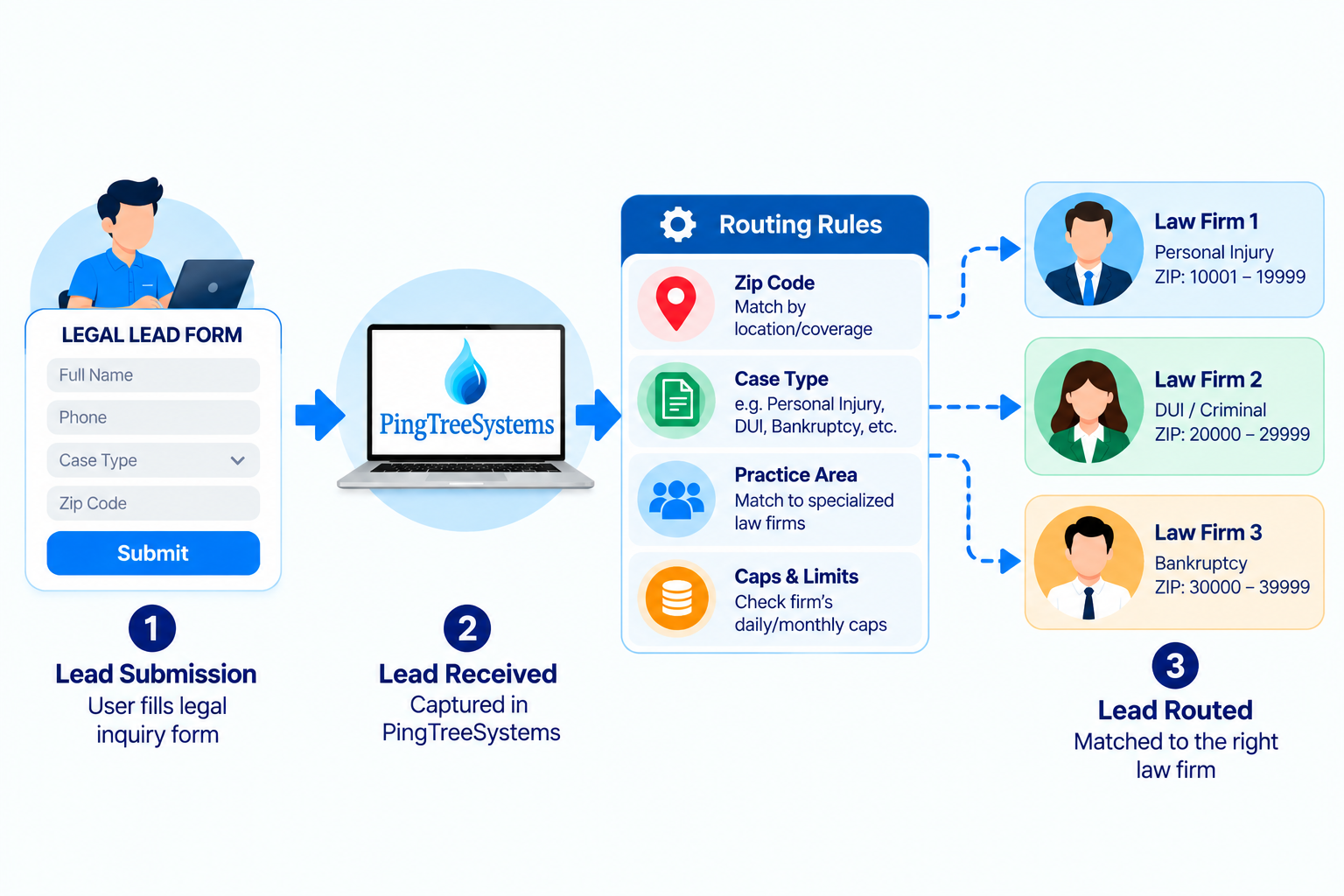
From intake form to matched firm in seconds.
3. Routing by Practice Area
Every practice area has different urgency, case value and intake needs. Good routing treats them differently:
Personal Injury
Time-sensitive and competitive. Filter by injury type, fault, medical treatment and statute of limitations.
Family Law
Divorce, custody and support. Route by county, case stage and whether the matter is contested.
Criminal Defense
Extremely urgent. Match by charge type, court location and available same-day attorneys.
Immigration
Filter by case type, language and visa status needs, with language-matched intake staff.
Workers' Compensation
Route by state rules, injury date and employer details.
Bankruptcy and Estate
Planned matters with longer decision cycles. Debt levels, assets and timelines drive fit.
4. Routing Rules That Lift Conversion
Start with simple rules, then add detail as you collect data:
| Rule | What It Does | Conversion Benefit |
|---|---|---|
| Practice area | Sends the case only to firms that handle it | Removes wasted calls |
| Jurisdiction | Matches state, county or court location | Avoids unlicensed or out-of-area firms |
| Case criteria | Filters by case value, injury level or timeline | Higher signed-case rate |
| Language | Routes to intake staff who speak the client's language | Better first conversation |
| Capacity and caps | Limits leads per day, week or month | Prevents overloaded intake |
| Schedule | Delivers only during staffed hours, with after-hours backup | Faster real contact |
| Fallback tiers | Moves rejected leads to the next firm | Fewer unsold leads |
5. Speed to Contact in Legal Intake
People with legal problems are stressed and often contact several firms at once. The firm that answers first, listens well and explains the next step has a strong advantage. Routing supports speed in three ways:
- Real-time delivery: leads arrive by API, SMS or CRM alert within seconds.
- Instant first touch: an automatic text or email confirms the request while staff prepare to call.
- Round-the-clock coverage: overnight leads route to after-hours intake services or queue for the first call of the morning.
Our article on avoiding key lead generation errors covers many of the same response-time mistakes that affect legal intake.
6. Ping Post and Competitive Bidding
Where permitted, ping post lets multiple law firms compete for the same lead without exposing client details too early.
How Ping Post Works for Legal Leads
Inquiry submitted: A prospect describes their legal issue.
Ping: Non-identifying details (practice area, state, case type) go to matched firms.
Bid: Firms reply in about a second with a price or a pass.
Post: The winning firm receives the full inquiry. If it declines, the lead moves down the tree.
Competition sets prices by real demand, so a high-value injury case in a busy market earns more than a low-demand inquiry. See the controls available on our platform features page.
7. Quality, Consent and Ethics
Legal leads involve sensitive information, and the legal profession has strict rules on advertising and referrals. Build trust into your process:
- Clear consent: tell the person who may contact them and store consent records with timestamp and IP.
- Data validation: check phone, email and location in real time and block duplicates.
- Honest forms: avoid misleading claims or implying an attorney-client relationship before one exists.
- Privacy: share only the information a buyer needs, and secure it in transit and at rest.
- Smart forms: ask short, relevant questions. See how dynamic forms improve lead quality.
8. How to Set Up Smart Routing
Document each firm's criteria
Record practice areas, states, counties, case minimums, languages, hours and caps. Also note preferred case values, lead sources and geographic restrictions.
Standardize your intake fields
Use consistent case types and qualifying questions so filters work across all buyers. This makes matching faster, clearer and easier to manage. Keep important information organized for accurate routing decisions.
Build tiers and fallbacks
Place best-fit firms first, then secondary firms, so no valid lead is wasted. Create clear backup rules to ensure qualified opportunities are always routed efficiently.
Connect delivery and alerts
Push leads to the firm's CRM or intake system with instant notifications to the assigned person. Test delivery regularly to prevent missed opportunities and delays.
Review weekly and refine
Study rejection reasons, retained-case rates and response times, then adjust rules and payouts. Use performance trends to improve routing accuracy, buyer satisfaction and overall results.
9. Metrics to Track
The most important number for a law firm is cost per signed case, not cost per lead. For sellers, it is revenue per lead after returns. Track both by source and by practice area.
Conclusion: Put Every Legal Lead in the Right Hands
Legal lead conversion depends on fit and speed. Smart routing gives you both: the right case reaches the right firm, in seconds, with limits that protect intake teams from overload. Combined with clean data, clear consent and respect for professional rules, it turns a pile of inquiries into a reliable pipeline of signed cases. With the right Ping Tree System, all of this runs automatically.
Ready to improve legal lead conversion? Explore our Legal Leads solution or request a free demo →
Frequently Asked Questions
Legal lead routing is the automated process of sending each prospective client inquiry to the law firm or attorney whose practice area, location, case criteria and capacity match the lead.
It matches the right case to the right firm, delivers the lead within seconds, prevents overloaded intake teams and removes poor-fit inquiries. That raises contact rates, signed-case rates and buyer satisfaction.
As fast as possible, ideally within minutes. People with legal problems often contact several firms at once, and the firm that responds first with a clear, helpful conversation usually has the advantage.
Yes, where permitted. Ping post sends non-identifying case details to matched firms, collects bids in about a second and posts the full lead to the winner. Lead sellers and firms must follow applicable bar and advertising rules.
Yes. State bar rules on advertising, solicitation, referral fees and fee sharing vary by jurisdiction. Lead sellers and law firms should review local rules and consult qualified legal ethics counsel before buying or selling leads.
Yes. The platform supports real-time ping post, practice-area and jurisdiction filters, caps, schedules, bidding, tiered routing and reporting. You can learn more or book a demo at pingtreesystems.com/contact.