

A homeowner searches for a new roof, fills in a quote form, and expects a call soon. Meanwhile, your lead sits in a spreadsheet, waiting for someone to decide who should get it. By the time a contractor calls, the homeowner has already booked someone else. This is the most common and most expensive problem in the home improvement vertical, and lead routing is how you solve it.
This guide explains what home improvement lead routing is, which rules matter most, how ping post and ping trees fit in, and how to measure results. It also shows how lead distribution software automates the whole process.
Key Takeaway: Home improvement leads are local, project-specific and time-sensitive. The best routing sends each lead to a contractor who serves that ZIP code, offers that service and has capacity right now.
1. What Is Home Improvement Lead Routing?
Lead routing is the automated process of deciding which buyer receives each lead. In home improvement, a "buyer" might be a roofing company, an HVAC installer, a window dealer, a remodeler or a franchise network. Routing rules compare the details on the lead with each buyer's requirements and send the lead to the best match.
Done manually, routing creates delays, mistakes and unhappy buyers. Done with software, it takes seconds, follows the same rules every time, and scales when your lead volume grows. For publishers, that means more leads sold. For contractors, it means fewer wasted calls and more booked estimates.
2. Popular Home Improvement Lead Categories
Each category has its own buyers, pricing and urgency, so routing setups differ:
Roofing Leads
High ticket and often urgent after storms. Buyers are strict about service area.
HVAC Leads
Emergency repairs and replacements. Speed to contact is critical.
Window and Door Leads
Planned projects with longer decision cycles and comparison shopping.
Bath and Kitchen Remodel
Budget and timeline filters matter most for these projects.
Siding, Flooring and Landscaping
Seasonal demand with strong local competition.
Solar and Energy Upgrades
Homeownership, roof condition and utility details drive eligibility.
3. Routing Rules That Matter Most
The more precise your rules, the better your acceptance rate. These are the filters most contractors rely on:
- Geography: ZIP code lists, city, county, state or a radius around the contractor's office.
- Service type: roof replacement vs. repair, central AC vs. furnace, full remodel vs. single room.
- Homeownership: most buyers only want owners, not renters.
- Budget and project size: filter out jobs that are too small or too large for the buyer.
- Timeline: urgent requests go to buyers with same-day capacity.
- Capacity and caps: daily, weekly and per-ZIP limits protect busy crews from overload.
- Schedule: send leads only during hours when a team can actually call back.
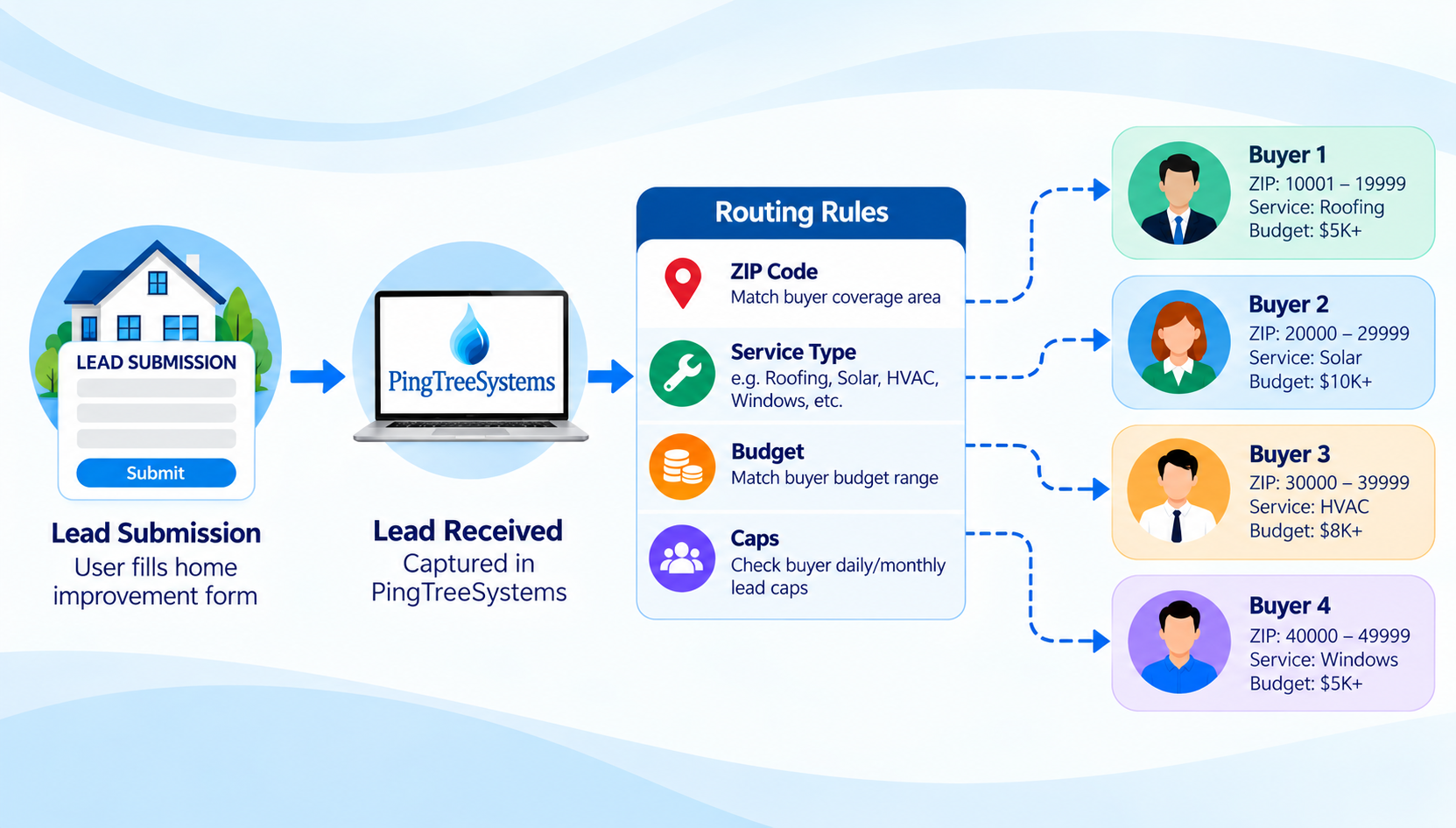
Stack simple rules (ZIP, service, caps) before adding advanced filters.
4. Ping Post and Ping Trees for Contractors
Rules decide who is eligible. A ping tree decides who gets the lead and at what price. It uses ping post, a two-step process that keeps the homeowner's contact details private until a buyer commits.
How Ping Post Works for Home Improvement Leads
Lead captured: A homeowner submits a roofing, HVAC or remodel request.
Ping: Project type, ZIP and budget range go to eligible contractors.
Bid: Each contractor responds with a price or a pass in about a second.
Post: The winning buyer receives the full lead. If rejected, it moves to the next tier.
Because buyers compete, pricing reflects real demand. A storm-damaged roof in a busy market may attract several bids, while a smaller job in a quiet area still reaches a buyer through the waterfall. Explore the controls on our platform features page, and read how a similar routing model works in auto insurance leads.
5. Exclusive vs. Shared Leads
| Factor | Exclusive Leads | Shared Leads |
|---|---|---|
| Buyers per lead | One contractor | Two to four contractors |
| Price | Higher | Lower |
| Homeowner experience | One clear contact | Several calls at once |
| Contractor win rate | Usually higher | Lower, price-driven |
| Best for | High-ticket jobs such as roofs and remodels | Lower-ticket or high-volume services |
You do not have to choose only one. Many sellers route the first sale as exclusive, then offer unsold or aged leads as shared, which raises total revenue per lead.
6. Lead Quality and Compliance
Routing is only as good as the data it works with. Protect quality at the form and at the point of sale, while maintaining consistent compliance standards:
- Smart forms: ask project type, timeline and homeownership. See how dynamic forms improve lead quality.
- Validation: verify phone, email and ZIP in real time, and block duplicates.
- Consent records: store timestamp, IP and consent text for every lead.
- Fraud filters: block bots and repeated submissions from the same device.
7. How to Build Your Routing Setup
Collect buyer requirements
Record each contractor's ZIP list, services, minimum budget, hours and caps. Also document preferred lead types and daily volume limits.
Standardize your lead fields
Use consistent project types and budget ranges so filters match across all buyers. This keeps routing accurate and reduces manual corrections.
Create tiers and fallbacks
Place premium buyers first, then mid-tier, then shared buyers as a safety net. Define clear fallback rules for unmatched leads.
Connect delivery
Send leads by API, email, SMS or CRM so contractors can call within minutes. Confirm every delivery channel works reliably before launch.
Review and tune weekly
Check rejection reasons, adjust payouts, update ZIP lists and pause weak traffic sources. Track results regularly to improve overall lead quality.
8. Metrics to Track
Review these by service type, traffic source and buyer. A source that looks cheap but produces renters or out-of-area leads will show up quickly in return rates.
Conclusion: Route Smarter, Book More Jobs
Home improvement is a local business, and every lead is a specific job in a specific place. Smart routing respects that. By combining clear filters, ping post, tiered buyers and caps, you send each homeowner to a contractor who wants the job and can do it. Sellers earn more per lead, and contractors fill their calendars with better-fit estimates. With the right Ping Tree System, all of this runs automatically in real time.
Ready to route home improvement leads automatically? Explore our Home Improvement Leads solution or request a free demo →
Frequently Asked Questions
It is the automated process of sending each homeowner request, such as roofing, windows or HVAC, to the contractor or company whose service area, project type and budget rules match the lead.
Use routing rules based on ZIP code or radius, service type, project size, timeline and homeownership status. A lead distribution platform applies these filters in real time and sends the lead to the best-matched buyer.
Exclusive leads go to one contractor and usually convert better but cost more. Shared leads go to several contractors at a lower price. Many sellers offer both and use a ping tree to price each lead by demand.
Yes. Ping post sends partial lead details to matched contractors, collects bids in about a second, and posts the full lead to the winning buyer. It works well for roofing, HVAC, windows, siding, flooring and remodeling.
Set daily, weekly and monthly caps for each buyer, add per-ZIP limits, and use time-of-day schedules. When a buyer reaches a cap, the platform automatically sends the lead to the next eligible buyer.
Yes. The platform supports real-time ping post, geographic and service filters, caps, bidding, tiered routing and reporting. You can learn more or book a demo at pingtreesystems.com/contact.