

Auto insurance is one of the most competitive lead verticals online. Millions of drivers compare quotes every year, and dozens of carriers and agencies bid for the same shoppers. In that market, generating a lead is only half the job. The other half is getting that lead to the right buyer, at the right price, in seconds. That is where ping trees come in.
This guide covers the full picture: the types of auto insurance leads, where they come from, how a ping tree works, how to protect lead quality, and which metrics to track. It also shows how modern lead distribution software ties it all together.
Key Takeaway: Strong auto insurance lead generation needs three things working together: quality traffic, clean data, and real-time distribution. A ping tree handles the third piece by turning every lead into a competitive auction.
1. What Is Auto Insurance Lead Generation?
Auto insurance lead generation is the process of attracting drivers who want a quote, capturing their details through a form or call, and passing that information to an insurer or agent. A typical lead includes name, contact details, ZIP code, vehicle information, driver history and current coverage.
Publishers and lead generators earn revenue by selling these leads. Carriers and agencies buy them because it is faster and more predictable than waiting for walk-in business. The challenge is that buyers want different things: one wants clean-record drivers in Texas, another wants high-mileage drivers in Florida, and a third only wants leads with a policy expiring within 30 days. Matching leads to those preferences automatically is the core problem a ping tree solves.
2. Types of Auto Insurance Leads
Knowing the lead types helps you price, route and buy correctly:
Exclusive Leads
Sold to one buyer only. Higher price, higher contact and close rates.
Shared Leads
Sold to several buyers. Lower price, but more competition for the shopper.
Real-Time Leads
Delivered within seconds of form submission through API or ping post.
Aged Leads
Older leads sold at a discount. Useful for nurturing and re-marketing.
Live Transfers
The shopper is connected to an agent on a live call. Premium price.
Inbound Call Leads
Drivers who call a tracking number after seeing an ad or search result.
3. Where Auto Insurance Leads Come From
Most publishers combine several traffic channels, then compare the lead quality from each one:
- Search (SEO and PPC): high intent, because drivers search for terms like "cheap car insurance quotes".
- Social ads: strong reach and good targeting, but intent is lower and follow-up speed matters more.
- Comparison sites: shoppers who already want multiple quotes.
- Content and email: long-term, lower-cost traffic from guides and newsletters.
- Affiliate and network partners: scale quickly but need tight quality controls.
Whatever the source, track every lead back to it with source IDs and sub IDs. That is the only way to know which campaigns earn money and which only produce volume. Our guide on automating your auto insurance lead workflow with Zapier shows how to connect sources to your CRM.
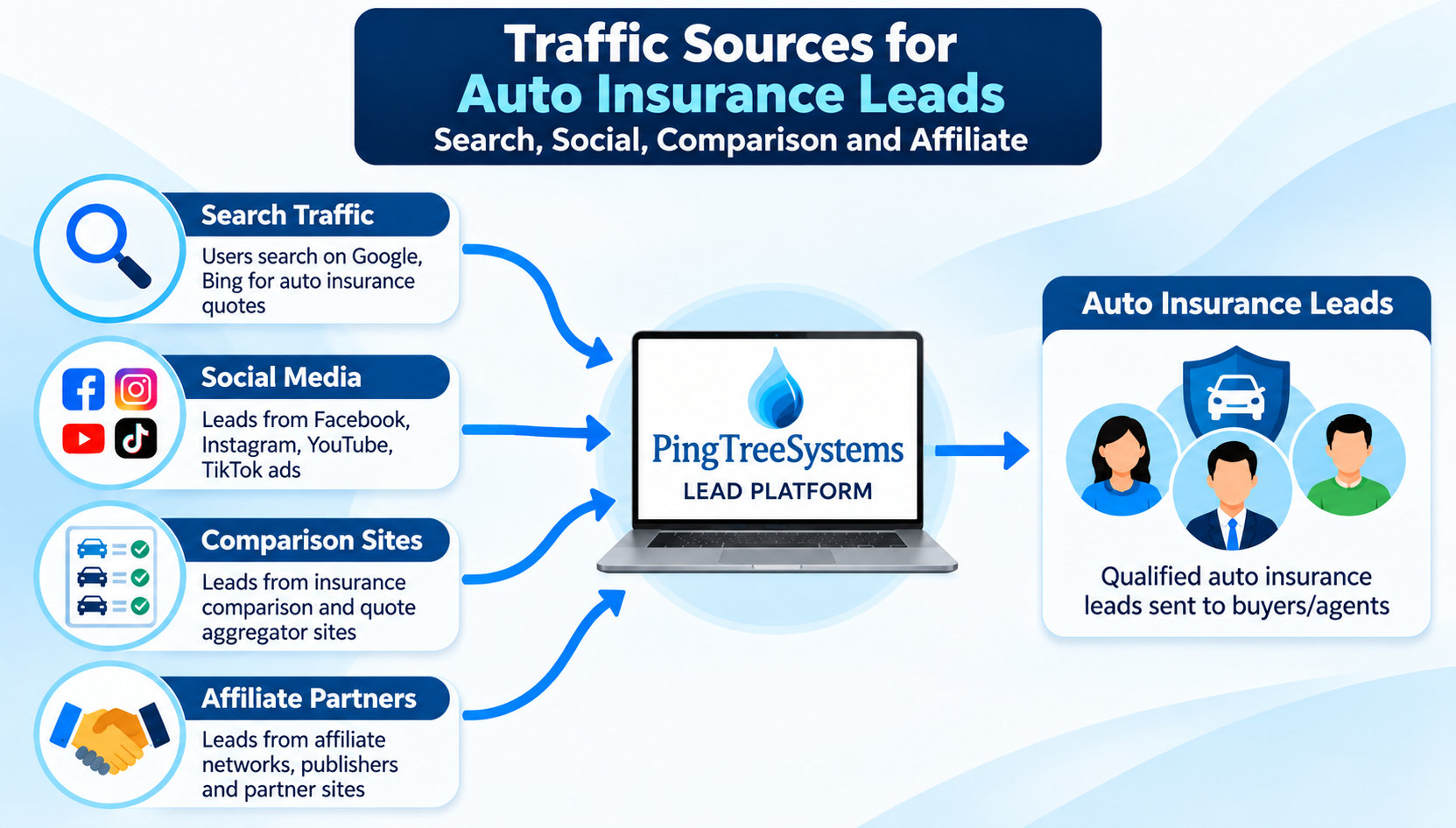
Compare lead quality by traffic source, not just lead volume.
4. What Is a Ping Tree?
A ping tree is a ranked list of buyers that a lead moves through in real time. It uses ping post technology, a two-step process that protects personal data until a buyer commits to purchase.
How Ping Post Works
Lead submitted: A driver completes the quote form.
Ping: Partial data (state, age range, vehicle, coverage) is sent to matched buyers.
Bid: Each buyer replies in about a second with a price or a pass.
Post: The full lead goes to the winner. If they reject it, it drops to the next buyer.
The "tree" part is the order of buyers. Buyers sit on different tiers based on payout, priority, daily caps and filters. If the top tier passes, the lead falls to the next one, so almost every valid lead finds a home. See what you can configure on our platform features page.
5. Benefits for Publishers and Buyers
| Area | Publishers / Lead Sellers | Buyers / Agencies / Carriers |
|---|---|---|
| Revenue and cost | Bidding raises revenue per lead | Pay market price and control spend with caps |
| Speed | Leads sold instantly, nothing sits in a queue | Contact shoppers while intent is high |
| Fit | Fewer rejected leads thanks to filters | Receive only the states, drivers and coverage they want |
| Fill rate | Waterfall fallback monetizes more leads | Lead flow stays steady across the day |
| Visibility | Live reports by source and buyer | Track cost per lead, per sale and return rate |
6. How to Protect Lead Quality
Buyers pay more for clean, contactable leads, and they leave when quality drops. Build these checks into your funnel:
- Dynamic forms: show only relevant questions and reduce drop-off. See dynamic forms to improve auto insurance lead quality
- Real-time validation: verify phone, email, ZIP and VIN format before the lead is sold.
- Duplicate checks: block repeat submissions within a set window.
- Consent capture: store timestamp, IP address and consent text for every lead.
- Bot and fraud filters: detect scripted or incentivized junk traffic early.
7. How to Set Up a Ping Tree
Define your buyers
List each buyer's states, coverage types, driver rules, daily caps and payout, along with their lead volume requirements and preferred submission times.
Map your lead fields
Match your form fields to each buyer's API format, including required and optional data, while ensuring all values meet their validation and formatting requirements.
Set filters and tiers
Rank buyers by priority or highest bid, then add time-of-day and geography filters, while considering lead quality, buyer capacity and current performance levels.
Test with live traffic
Send a small batch, check response times, rejection reasons and pricing, then fix gaps, monitor buyer responses closely and confirm successful lead delivery.
Scale and optimize
Add buyers and sources, adjust payouts weekly and drop underperforming traffic, while continuously reviewing conversion rates, revenue results and overall campaign performance.
8. Metrics That Matter
Review these weekly by traffic source, state and buyer. Small changes, like moving a buyer up a tier or pausing a low-quality sub ID, can add up quickly across thousands of leads.
Frequently Asked Questions
A ping tree is a ranked list of buyers that receive a partial auto insurance lead (a ping). Each buyer responds with a bid or a pass, and the full lead is posted to the winning buyer in real time. If a buyer declines, the lead moves down to the next buyer.
Ping post is the two-step process of sending partial data first and the full lead second. A ping tree is the ordered structure of buyers that the ping post process runs through, based on priority, price, filters and caps.
The main types are exclusive leads, shared leads, real-time leads, aged leads, live transfers and inbound call leads. Each differs in price, freshness and how many agents compete for the same shopper.
Use dynamic forms that collect the right data, validate phone and email in real time, remove duplicates, capture consent, and apply buyer filters so each lead matches the buyer's state, coverage and driver criteria.
It can be, when you collect clear consent, keep consent records, honor opt-outs and restrict calls and texts to permitted hours. Rules vary by state, so businesses should consult legal counsel.
Yes. The platform supports real-time ping post, buyer filters, caps, bidding, tiered routing and reporting for auto insurance. You can learn more or book a demo at pingtreesystems.com/contact.