The solar industry is booming — and so is the battle for qualified leads. With homeowners fielding offers from dozens of installers simultaneously, the difference between a thriving solar company and one that plateaus often comes down to a single question: How effectively do you capture and convert intent? The answer begins with your landing page, and it ends with how fast and intelligently you distribute each lead that page collects.
This guide walks through every dimension of landing page strategy for solar lead generation — from crafting a compelling user experience to integrating a Ping Tree Lead Distribution System that routes captured leads to the right buyer in real time. Whether you run a solar installation company, a lead generation network, or a marketing agency serving the energy sector, these principles translate directly to more booked consultations and a lower cost-per-acquisition.
1. Creating a Focused, Distraction-Free User Experience
A homepage tries to serve everyone. A landing page serves one purpose. This distinction is the single most important factor separating solar landing pages that convert at 2% from those that convert at 12% or higher.
Remove the full navigation bar. Strip away links to your blog, your about page, and your product catalog. The visitor arrived with one intent — to explore solar options — and your page should honor that intent by making a single path crystal clear: fill out the form, get the quote, book the call.
Integrating a Lead Distribution System at this stage means that every form submission is immediately processed, validated, and routed — not batched overnight. Real-time routing keeps the lead warm and dramatically improves the chance that the first call from your sales team reaches a homeowner who still remembers filling out your form.
Single Conversion Goal
Each landing page should have exactly one CTA — a quote request, consultation booking, or savings calculator. Multiple goals dilute focus and lower conversion.
No Navigation Leaks
Removing the top navigation menu typically increases landing page conversions by 10–25%, as visitors cannot wander to unrelated sections of the site.
Page Speed Under 2 Seconds
Every additional second of load time reduces conversions by ~7%. Compress images, use a CDN, and defer non-critical scripts for solar pages serving mobile users.
Real-Time Lead Routing
Pair your form with Ping Post Software to instantly distribute submissions to the highest-bidding qualified buyer, eliminating the cold-lead problem.
2. Capturing the Right Information — Without Overwhelming Visitors

Solar installers need to qualify leads before dispatching a sales team. But long forms drive abandonment. The solution is progressive profiling — collect the bare minimum upfront, then gather richer data on a thank-you page or in a follow-up sequence.
A high-performing solar landing page form typically asks for five fields or fewer:
- Full name — personalizes all follow-up communication immediately
- Email address — enables automated nurture sequences if the lead does not convert on first call
- Phone number — enables same-day outreach, the single biggest driver of solar lead conversion
- ZIP code or address — allows pre-qualification based on sun exposure, utility rates, and local incentives
- Monthly electricity bill (range) — the most predictive single variable for solar ROI and customer interest
When this data flows into a Solar Leads Distribution System like Ping Tree, each data point is available for real-time buyer matching. A buyer focused on high-bill residential customers in California will only receive leads that match — ensuring the highest bid for your publisher and the best fit for the buyer.
Why Ping Post Changes the Economics of Solar Lead Gen: Traditional lead buying is transactional: one lead, one price, one buyer. The Ping Post model runs a real-time auction. When a visitor submits your form, that lead data is "pinged" to multiple pre-approved buyers simultaneously. The highest bidder "posts" an acceptance and receives the lead in under a second. Publishers consistently earn 30–60% more per lead compared to fixed-price models — without any extra traffic.
3. Building Trust Before Asking for Personal Data
Solar installation is a $20,000–$40,000 decision for most homeowners. Visitors do not hand over their phone number to a company they have never heard of unless that company has visibly earned their trust. Your landing page has roughly 15 seconds to do that job.
These trust elements, placed above the fold or immediately adjacent to your form, consistently lift conversion rates:
Customer Testimonials with Photos
Real names, real faces, and specific savings figures ("Reduced my bill from $280 to $14/month") outperform generic five-star quotes by a wide margin.
Industry Certifications
NABCEP certification badges, manufacturer partner logos, and BBB ratings reduce anxiety at the point of form completion.
Privacy Guarantees
A one-line commitment — "We never sell your information to third parties" — placed next to the submit button measurably reduces form abandonment.
Local Project Data
"We've installed 1,240 systems in [State] this year" is more persuasive than any national statistic. Geo-personalized social proof converts.
4. Communicating a Clear, Compelling Value Proposition
Most solar landing pages lead with the product ("High-efficiency monocrystalline panels"). The highest-converting pages lead with the outcome the customer actually wants: lower bills, energy independence, or a specific dollar savings figure calculated for their region.
Your headline should answer one question in under eight words: Why should I switch to solar right now?
Supporting copy should cover three pillars:
5. Visual Design That Communicates Before the Copy Does
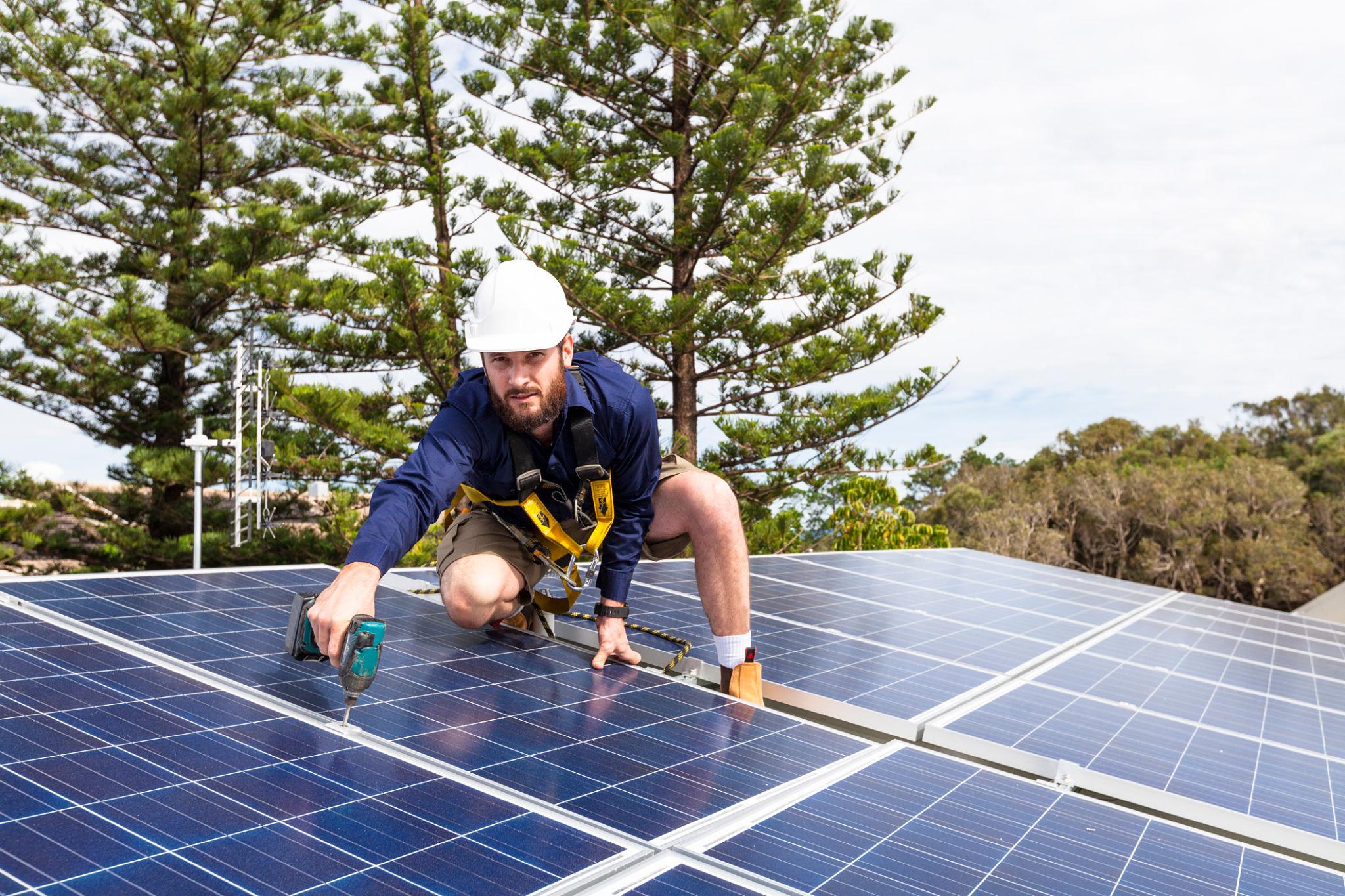
Solar is a visually compelling product. A landing page that opens with a photograph of a clean, modern rooftop installation in a neighborhood that looks like the visitor's own immediately builds aspiration and relatability. Generic stock images of a glowing planet or abstract energy graphics do the opposite.
Design principles that specifically lift solar landing page performance:
- Use real customer installation photos — with permission — rather than manufacturer stock imagery.
- Incorporate an interactive savings calculator: visitors who engage with a calculator convert at 2x the rate of those who only read copy.
- Use video testimonials auto-playing silently above the fold. Even 15-second clips increase time-on-page by an average of 2 minutes.
- Infographics showing the installation process step-by-step reduce the perceived complexity of going solar and remove a major psychological barrier to conversion.
Landing Page Strategy vs. Lead Source: What Converts Best?
Not all solar lead sources are equal, and not all landing page strategies suit every channel. This table maps the most common combinations to help you prioritize your budget and testing roadmap.
| Lead Source | Recommended Landing Page Type | Avg. Conversion Rate | Ping Post Compatible | Typical Cost per Lead |
|---|---|---|---|---|
| Google Search Ads | Single-CTA quote form, minimal copy | 8–14% | Yes | $45–$90 |
| Facebook / Meta Ads | Story-driven, savings-first with social proof | 4–9% | Yes | $25–$60 |
| Organic SEO | Long-form educational page with multiple CTAs | 2–5% | Yes | $10–$30 |
| YouTube Pre-Roll | High-visual, before/after savings focus | 3–7% | Partial | $30–$70 |
| Email Campaigns | Personalized with pre-filled form fields | 6–11% | Yes | $15–$40 |
| Door-to-Door / Events | QR code to simple mobile form | 1–3% | Limited | $80–$150 |
6. Writing CTAs That Create Urgency Without Pressure
The call-to-action button is the single highest-leverage element on a solar landing page. Its text, color, placement, and surrounding copy all influence whether a visitor clicks or bounces. The most effective solar CTAs share three characteristics:
- Outcome-specific language: "See My Estimated Savings" converts better than "Submit" because it tells visitors exactly what they receive in return for their information.
- Low-commitment framing: "Get a Free, No-Obligation Quote" neutralizes the fear that clicking starts a high-pressure sales process — a primary concern for solar shoppers.
- Visual contrast: Your CTA button should be the most visually prominent element on the page — a color that appears nowhere else in the design, making it impossible to miss.
8. Mobile-First Design Is No Longer Optional
More than 65% of solar landing page traffic in 2025 originates from smartphones. A form that requires pinching and zooming, a CTA button a thumb cannot comfortably reach, or a page that takes five seconds to load on a 4G connection will lose more leads than any targeting mistake could cause.
Mobile optimization essentials for solar landing pages:
- Single-column layout that scrolls naturally on any screen width without horizontal scrolling
- Tap-to-call button prominently displayed — many mobile visitors prefer calling over filling out forms
- Form fields with appropriate mobile keyboard types (numeric for phone, email keyboard for email fields)
- Autofill support using standard HTML autocomplete attributes to minimize typing friction
- WebP image format with responsive srcset attributes for fast loading on mobile data connections