

Every auto finance lead has a shelf life measured in minutes. A shopper who submits a financing form is comparing offers, visiting dealerships and answering calls right now. If your lead reaches the wrong lender, arrives late, or sits in a manual queue, the opportunity is gone. That is why auto finance lead distribution has become one of the biggest profit levers for publishers, lenders and dealer groups.
This guide explains how ping tree technology fixes the weak points of traditional routing, what features matter most, and how to measure results. If you are new to the model, start with our overview of lead distribution software.
Key Takeaway: A ping tree turns every auto finance lead into a real-time auction. The right lender wins, the publisher earns more per lead, and the consumer is contacted within seconds.
Why Lead Distribution Matters in Auto Finance
Auto loans are a high-value, high-competition vertical. Buyers range from prime banks and credit unions to subprime lenders and buy-here-pay-here dealers, and each has different rules for credit score, income, loan amount, vehicle age and state. Sending every lead to one buyer, or rotating leads on a fixed schedule, creates three costly problems:
- Mismatched leads: a subprime applicant sent to a prime-only lender gets rejected, wasting the lead.
- Underpriced leads: fixed-price contracts ignore what buyers would pay for a strong applicant.
- Slow response: batch delivery and manual emails let competing lenders reach the consumer first.
Interest rate shifts make this worse, as we covered in The Impact of Interest Rates on Auto Loan Leads. Buyer criteria change often, so your routing must be able to change with them.
What Is Ping Tree Technology?
A ping tree (also called ping post or a lead waterfall) is a two-step distribution method. First, the platform sends a ping: a partial, non-personal lead record such as credit range, loan amount, state and vehicle type. Second, each eligible buyer replies with a bid or a pass. The platform then posts the full lead, including contact details, to the winning buyer.
The "tree" is the ranked order of buyers. Buyers are grouped by priority, payout, caps and filters. If the top buyer rejects or times out, the lead drops down to the next branch automatically, so nothing is wasted.
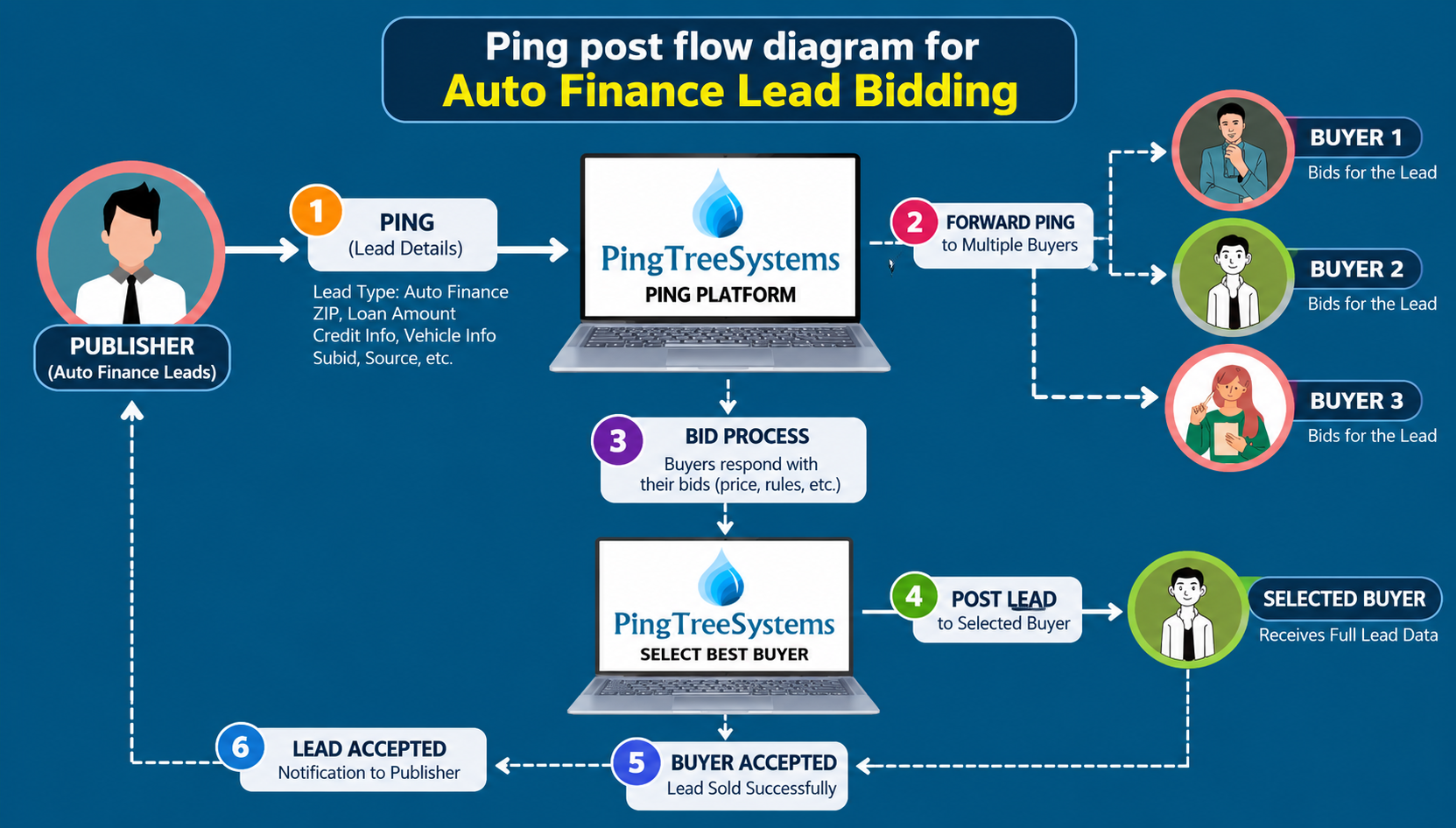
Ping, bid, post: how an auto finance lead moves through a ping tree.
5 Ways Ping Tree Technology Improves Auto Finance Lead Distribution
1. Real-Time Routing at Peak Intent
Because the ping, bid and post cycle finishes in about a second, the winning lender can call or text the applicant while the form is still fresh. Speed to contact is one of the strongest predictors of funded loans, and automation removes the human delay.
2. Precision Buyer Filters
Each buyer sets its own rules: credit tier, income minimum, loan amount, vehicle year, down payment, state and time of day. The ping tree checks those rules before a lead is offered, which means higher acceptance rates and fewer returns. Lenders see only the leads they want to fund.
3. Competitive Bidding for Higher Revenue per Lead
Fixed-price deals leave money on the table. When several buyers bid on the same applicant, the price reflects real demand. A strong prime lead can command a premium, while a thinner profile still finds a buyer at the right price. Publishers see higher EPL and lenders get a fair, transparent market.
4. Waterfall Fallback and Smart Caps
If the first buyer hits a daily cap, goes offline or declines, the lead moves to the next buyer instead of expiring. You can also set daily, weekly and monthly caps per buyer to control spend and protect lender relationships. Our platform features page covers caps, priorities and scheduling in detail.
5. Data Validation and Compliance Controls
Bad data kills conversion. Phone, email and address validation at intake removes fake or unreachable submissions before they reach a buyer. A good platform also stores consent records and lets you block non-approved buyers, supporting TCPA readiness.
Traditional Distribution vs. Ping Tree Distribution
| Factor | Traditional / Manual | Ping Tree Technology |
|---|---|---|
| Delivery speed | Minutes to hours (batch or email) | About one second, real time |
| Pricing | Fixed price per lead | Competitive bidding |
| Buyer matching | Static rotation | Rule-based filters per buyer |
| Rejected leads | Often wasted | Waterfall to next buyer |
| Reporting | Spreadsheets, delayed | Live dashboards by buyer and source |
| Rule changes | Days or weeks | Updated instantly |
Example: Routing by Credit Tier
Imagine a publisher receives three auto finance leads in one minute. Lead A has a 740 score and a $28,000 request. Lead B has a 610 score and a used-vehicle request. Lead C has a 520 score and a $4,000 down payment.
Lead A: Prime
Goes to bank and credit union buyers. Several bid, and the highest bid wins.
Lead B: Near-Prime
Skips prime-only buyers and goes to mid-tier lenders whose filters accept the profile.
Lead C: Subprime
Reaches subprime lenders and buy-here-pay-here dealers who value the down payment.
Without a ping tree, all three leads might go to one buyer and two would be rejected. With a ping tree, all three are monetized to the best-fit buyer in seconds. See how this works in our Auto Finance ping and post platform.
Metrics to Track After You Switch
- Revenue per lead (EPL): should rise as bidding competition grows.
- Buyer acceptance rate: improves when filters are accurate.
- Return and reject rate: falls with better validation.
- Time to contact: aim for seconds, not minutes.
- Lead-to-funded rate: the metric lenders care about most.
- Fill rate: share of leads that find a buyer anywhere in the tree.
Review these weekly by traffic source and credit tier so you can spot problems early and shift budget to what works.
Key Insight: Real-time qualification ensures that only high-quality, verified leads reach buyers, improving conversion rates and reducing wasted ad spend.
How to Choose a Ping Tree Platform for Auto Finance
Before you sign up, check that the software offers:
- Real-time ping post with sub-second response handling
- Flexible filters for credit, income, vehicle and geography
- Bidding, priority tiers, caps and scheduling
- Built-in validation and consent tracking
- API and CRM integrations for buyers and publishers
- Transparent pricing and responsive support
Operating across several verticals? The same engine also powers auto insurance leads, mortgage loan leads and payday loan leads.
Conclusion
Auto finance is fast, competitive and sensitive to market change. Ping tree technology gives publishers and lenders the speed, control and pricing power that manual distribution cannot match: real-time routing, precise buyer filters, competitive bids, automatic fallback and clean data. The result is higher revenue per lead, better acceptance rates and happier buyers.
Frequently Asked Questions
It is a distribution method where a partial auto finance lead is pinged to a ranked list of buyers. Each buyer bids or passes based on its criteria, and the full lead is posted to the winner in real time.
Multiple lenders and dealers bid on each qualified lead, so it sells at market value instead of a fixed price. Waterfall logic makes sure rejected leads still reach the next best buyer.
Yes. Credit-tier filters let subprime-focused lenders receive only the credit ranges, income levels and loan amounts they accept, while prime buyers are prioritized for stronger profiles.
A well-configured platform completes the ping, bid and post cycle in about one second, so the consumer is reached while purchase intent is highest.
It can support compliance by storing consent records, validating contact data and restricting distribution to approved buyers. You should still follow TCPA and state rules and consult legal counsel.