

Buying life insurance is an emotional decision that people often make in a small window of time. A new baby, a mortgage closing, a parent's health scare or a conversation with a spouse can push someone to fill in a quote form tonight. If that form sits in an inbox until tomorrow, the moment has passed and the shopper has either bought elsewhere or lost interest. For lead sellers and insurance agencies, real-time distribution is how you keep that moment alive.
This article follows a single life insurance lead from the instant it is submitted to the moment an agent picks up the phone. Along the way it explains what a ping tree actually does at each stage, how rules and bidding decide who gets the lead, and what to check when choosing lead distribution software.
Key Takeaway: A ping tree turns each life insurance lead into a live auction among pre-qualified buyers. The lead is checked, matched, priced and delivered within seconds, so the shopper is contacted while intent is still high.
Why Real Time Matters in Life Insurance
Life insurance shoppers rarely request a single quote. They compare several, often within the same hour, and they tend to speak with the agent who reaches them first and makes the process feel simple. Unlike many products, there is no urgent physical need that keeps them waiting for you. Intent fades quickly, and every hour of delay gives competing agents a head start.
Batch delivery, where leads are collected and sent by email or spreadsheet, worsens this problem. By the time an agent sees the lead, the shopper may already be on the phone with someone else. Real-time delivery reverses the odds. It is also better for sellers, because a lead sold instantly to the best-fit buyer earns more than one that sits unsold until it ages.
Life Insurance Lead Types a Ping Tree Can Handle
Not every buyer wants the same shopper, which is exactly why a flexible routing engine matters. The most common categories each have their own audience and economics:
Term Life
Younger families and homeowners seeking affordable coverage for a set number of years.
Mortgage Protection
New homeowners, often triggered by closing dates or lender mail.
Final Expense
Older shoppers focused on burial and end-of-life costs, with smaller coverage amounts.
Whole and Universal Life
Permanent coverage buyers with cash value goals and larger budgets.
Indexed Universal Life
Higher-income shoppers comparing protection with long-term savings.
Veteran and Group Leads
Niche audiences with specialized programs and eligibility rules.
The Journey of a Lead: From Form to Phone Call
The easiest way to understand real-time distribution is to follow one lead. Imagine a 38-year-old homeowner who has just completed a term life quote form asking for $500,000 of coverage. Here is what the system does before that person has even closed the browser tab.
Validation comes first. Before any buyer sees the lead, the platform checks that the phone number is real, the email is deliverable and the ZIP code matches the stated state. It also looks for duplicates and obvious bot behavior. This protects buyers from paying for junk and protects sellers from returns.
The ping tells buyers just enough. The platform sends only non-personal details such as age range, state, coverage amount, tobacco use and policy type. Each buyer's system compares that summary against its own rules and answers with a price or a pass, usually in under a second. Names, phone numbers and email addresses stay hidden until a buyer commits.
The tree decides the order. Buyers are arranged in tiers by priority, payout and filters. The highest bid, or the highest-priority eligible buyer, wins. The full lead is then posted to that buyer. If the buyer rejects the post, times out or has hit a cap, the lead drops to the next tier automatically, so very few valid leads go unsold.
Delivery gets it to a human. The winning agent or agency receives the lead by API into a CRM or dialer, with an alert for the assigned person. This last step is where many teams lose the advantage they just gained, which is why delivery and follow-up deserve as much attention as routing itself.
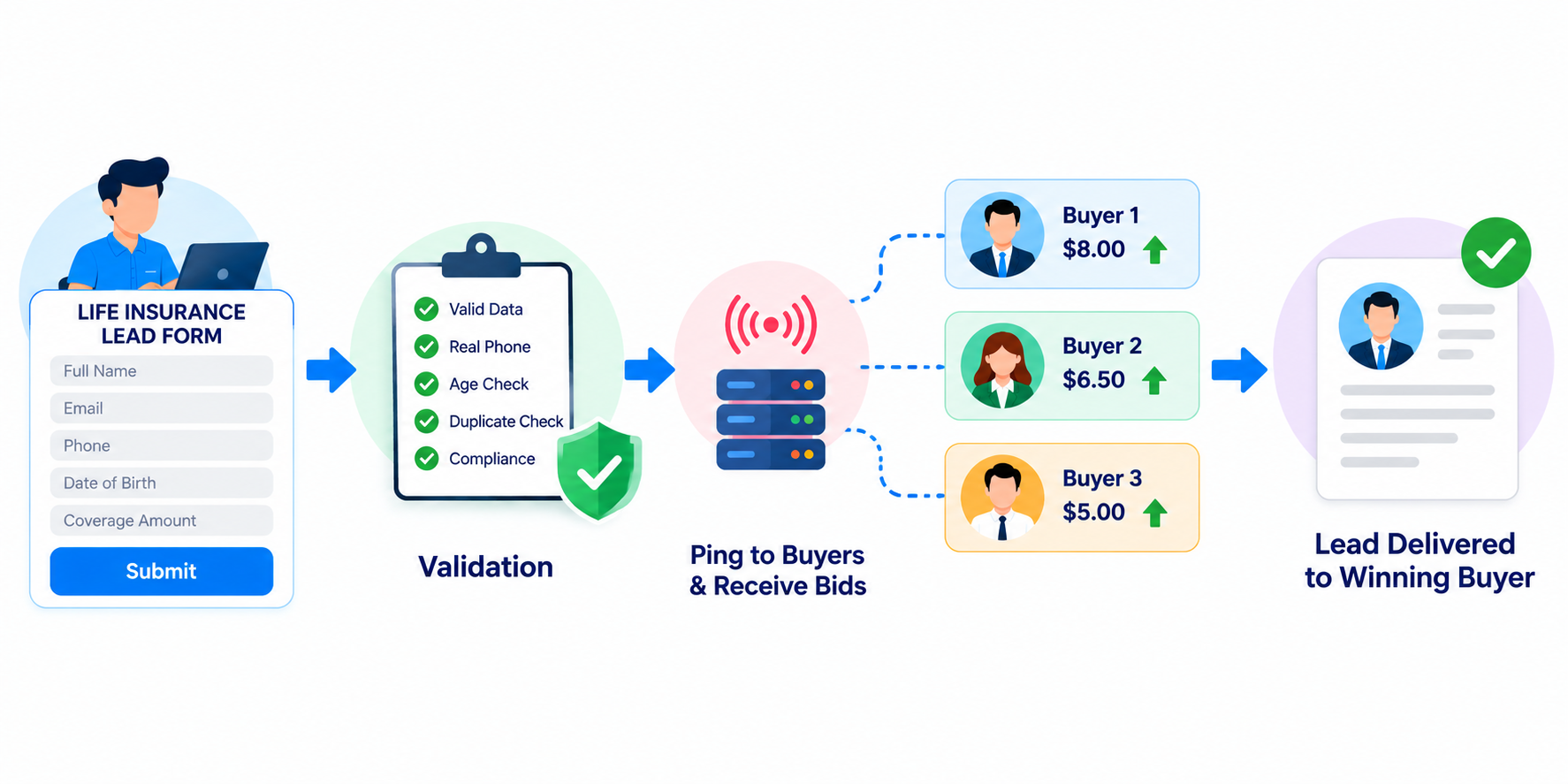
Every stage happens automatically, before the shopper leaves the page.
Routing Rules That Decide Who Gets the Lead
Rules turn a general stream of leads into a precise match for each buyer. The most useful filters in life insurance combine consumer details with the buyer's business model:
| Filter | Example Rule | Why It Matters |
|---|---|---|
| State and licensing | Send only to agents licensed in the lead's state | Prevents unlicensed contact and wasted leads |
| Age range | Final expense buyer accepts ages 50 to 80 | Matches product to audience |
| Coverage amount | Term buyer wants $250,000 and above | Protects agent time and commission goals |
| Tobacco and health class | Carrier appetite excludes certain risk profiles | Reduces declined applications |
| Policy type | Mortgage protection only | Keeps product focus clean |
| Caps and schedules | Fifty leads per day, 9 AM to 7 PM local time | Controls budget and call capacity |
Starting with just state, age and policy type is usually enough to see a quick improvement. You can add coverage amount, health class and scheduling once you have a few weeks of data on what each buyer actually converts.
Exclusive, Shared and Why Pricing Becomes Dynamic
An exclusive lead goes to one buyer and generally commands a higher price because the agent does not compete with others. A shared lead goes to several buyers at a lower price per buyer. A ping tree lets you offer both, for example by selling the lead exclusively to the top bidder first and releasing unsold leads as shared or aged inventory later.
Bidding also introduces dynamic pricing. A 35-year-old nonsmoker asking for a large term policy in a state with many active agents may attract strong bids, while a smaller, harder-to-place profile may sell for less. Instead of guessing a single flat price, you let demand set it, which tends to lift revenue per lead for sellers and keeps costs fair for buyers who only pay for what they actually want.
Compliance, Consent and Sensitive Data
Life insurance forms collect personal and sometimes health-related information, so handling it carefully is part of the product. Capture clear consent at submission, store the timestamp, IP address and consent language, and share contact details only with the buyer who wins the lead. Agents must be licensed in the consumer's state, and calls and texts must follow TCPA and state rules, including permitted calling hours and opt-out handling.
After Delivery: Where Real-Time Leads Are Won or Lost
Getting a lead to an agent in one second only helps if the agent responds quickly. The best-performing teams connect distribution directly to a CRM or dialer so the lead appears with a push or SMS alert, and they send an automatic text or email confirming the request while the agent prepares to call. Our guide on how a CRM helps convert insurance leads into sales walks through this setup in detail.
Timing also matters beyond the first call. Mid-morning and late-afternoon windows tend to work better than lunch hours or early mornings, and calls must respect the shopper's local time zone. If you want a deeper look, read our article on avoiding common insurance lead generation errors.
Choosing a Ping Tree Platform for Life Insurance
When you compare platforms, look past the sales page and test how the system handles real traffic. Confirm that it supports real-time ping post with fast timeouts, detailed filters for age, state, coverage and policy type, bidding with tiered priorities, buyer caps and schedules, built-in validation, and reporting by source and buyer. API and CRM integrations matter just as much, because they decide whether leads reach agents quickly. Finally, check pricing and support responsiveness, since you will need help when a buyer changes their criteria.
It also helps to clear up a few common beliefs before you decide:
Myth
Real-time leads cost too much, so aged leads are always the smarter buy.
Reality
Real-time leads cost more per lead but often less per sale, because contact and close rates are higher.
Myth
A ping tree only benefits lead sellers.
Reality
Buyers gain control through filters and caps, and receive leads that match their licensing, products and budget.
Metrics Worth Watching
Sellers should watch revenue per lead, fill rate and return rate. Buyers should focus on speed to contact, contact rate, quote-to-application rate and, most importantly, cost per issued policy. Review all of them by traffic source, policy type and buyer, since averages can hide both your best and worst performers.
Conclusion: Speed and Fit Are the Whole Game
Real-time distribution works because it respects how life insurance shoppers behave and how agents earn. Validation keeps lead quality high, filters keep matches precise, bidding keeps pricing fair and automated delivery keeps response times short. When those pieces work together in a well-configured Ping Tree System, sellers earn more from every lead and agents spend their time with people who are ready to talk.
Ready to distribute life insurance leads in real time? Explore our Life Insurance Leads solution or request a free demo →
Frequently Asked Questions
It means a life insurance lead is validated, matched to eligible buyers, priced and delivered within seconds of the consumer submitting a form, instead of being batched and sent later.
A ping tree sends non-identifying lead details to a ranked list of buyers. Each buyer returns a bid or a pass, and the full lead is posted to the winner. If the winner rejects it, the lead moves to the next buyer.
Term life, whole life, final expense, mortgage protection, indexed universal life and similar leads can all be distributed, as long as buyers can define their criteria by age, coverage amount, state and other fields.
Agents connect their CRM or dialer to the distribution platform by API, so each matched lead arrives instantly with an alert. Faster delivery lets agents call while the shopper is still thinking about coverage.
It can be when consent is captured and stored, agents are licensed in the consumer's state, and calls and texts follow TCPA and state rules. Businesses should consult qualified legal counsel for their situation.
Yes. The platform supports real-time ping post, state, age and coverage filters, bidding, tiered routing, caps, schedules and reporting. You can learn more or book a demo at pingtreesystems.com/contact.