

Every fall, millions of Americans start paying attention to their Medicare coverage, and a large share of them go online to compare plans. For agents and agencies, that creates a short, intense season in which the number of leads that arrive matters less than how well each one is handled. A Medicare lead that reaches the wrong agent, or reaches the right agent too late, is simply wasted.
Medicare lead distribution platforms exist to prevent that waste. They sit between the places where leads are created and the agents who work them, and they make dozens of small decisions in the seconds after a form is submitted. This guide explains what those decisions are, who is involved, how compliance fits in, and what to look for in lead distribution software.
Key Takeaway: A Medicare lead distribution platform captures a prospect's request, verifies it, matches it to a licensed and eligible buyer, and delivers it fast, all while keeping a record of consent that protects everyone involved.
What a Medicare Lead Distribution Platform Actually Does
At its simplest, a distribution platform is a traffic controller. Leads arrive from websites, call tracking numbers, partner networks and ad campaigns, each in a slightly different format. The platform standardizes them, checks their quality, decides which buyer should receive each one and sends it along. It then reports back on what happened so both sides can improve.
Without that layer, teams rely on spreadsheets, shared inboxes or manual forwarding. That might work for a handful of leads a week, but it breaks down quickly when volume spikes. A good platform scales with the season and applies the same rules at midnight on a Sunday as it does at noon on a Tuesday.
Who Is Involved in the Medicare Lead Chain
Three kinds of participants meet inside a distribution platform, and each has different goals:
Publishers and Lead Generators
They attract Medicare shoppers through search, content, social and partners, and earn revenue when leads are sold. They want high acceptance and fair prices.
The Platform
It validates, routes, prices and delivers leads, tracks consent and produces the reports that explain which sources and buyers perform best.
Agents, Agencies and Carriers
They want licensed-state matches, the right plan interest and quick delivery so they can reach people while interest is high.
Why the Medicare Calendar Shapes Everything
Medicare is unusual because most shoppers can only change coverage during specific windows. That calendar drives lead volume, buyer budgets and the pressure on speed. Always confirm current dates at Medicare.gov, but the main periods are well established:
Annual Enrollment
Peak season for plan comparison and switching.
MA Open Enrollment
Medicare Advantage members can make a plan change.
Initial Enrollment
Surrounds a person's 65th birthday month.
Special Periods
Moves, coverage loss and other triggers.
Because the Annual Enrollment Period is so concentrated, platform capacity and rules need to be tested before it begins. Caps, schedules and fallback buyers that were fine in summer can be overwhelmed in October.
Medicare Lead Types and Who Wants Them
Not every Medicare lead is the same product, and buyers are rarely interested in all of them. Clear categories let the platform send each shopper where they fit best.
| Lead Type | Typical Shopper | What Buyers Care About |
|---|---|---|
| Medicare Advantage | People comparing all-in-one plans | County and plan availability, carrier appointments |
| Medicare Supplement | Those with Original Medicare seeking gap coverage | State, age, health underwriting rules |
| Part D Drug Plans | Shoppers focused on prescription costs | Medication lists and pharmacy preferences |
| Turning 65 | New enrollees in their initial window | Birth month, current employer coverage |
| Dual-Eligible and Special Needs | Those with Medicaid or chronic conditions | Eligibility checks and specialized plans |
Inside the Platform: What Happens to Each Lead
When a lead enters the platform, the first job is intake. The platform accepts the data by form post, API or call integration, then maps each field to a standard format so every buyer receives clean, consistent information. It also records the source and sub-source, which later makes it possible to see which campaigns produce valuable leads and which merely produce volume.
Next comes validation and consent. The platform checks that the phone number and email are real, the ZIP code matches the state, and the lead is not a duplicate of one received recently. It also stores consent details such as timestamp, IP address, the page that collected the lead and the exact language the consumer agreed to. This record matters enormously if a call or text is ever questioned.
The third step is matching. The platform compares the lead against each buyer's rules. An agent licensed in Ohio and Pennsylvania should never see a Florida lead, and a Medicare Supplement specialist should not receive Advantage-only inquiries. Buyers can also set daily caps and calling hours so the platform sends only as many leads as a team can realistically work.
Fourth is pricing or priority. In a ping post setup, the platform sends non-identifying details to matched buyers, who respond with a price or a pass, and the winner receives the full lead. Other setups use fixed priority tiers or round-robin rotation among a team. Either way, rejected or unclaimed leads fall to the next eligible buyer so few go unsold. You can see the options on our platform features page.
Finally, delivery and reporting close the loop. The lead is pushed into the agent's CRM or dialer by API, with an alert for the assigned person. Dashboards then show contact rates, returns, revenue or cost per lead, and performance by source, so that rules can be adjusted. Our guide on how a CRM helps convert insurance leads into sales explains what to do once the lead lands.
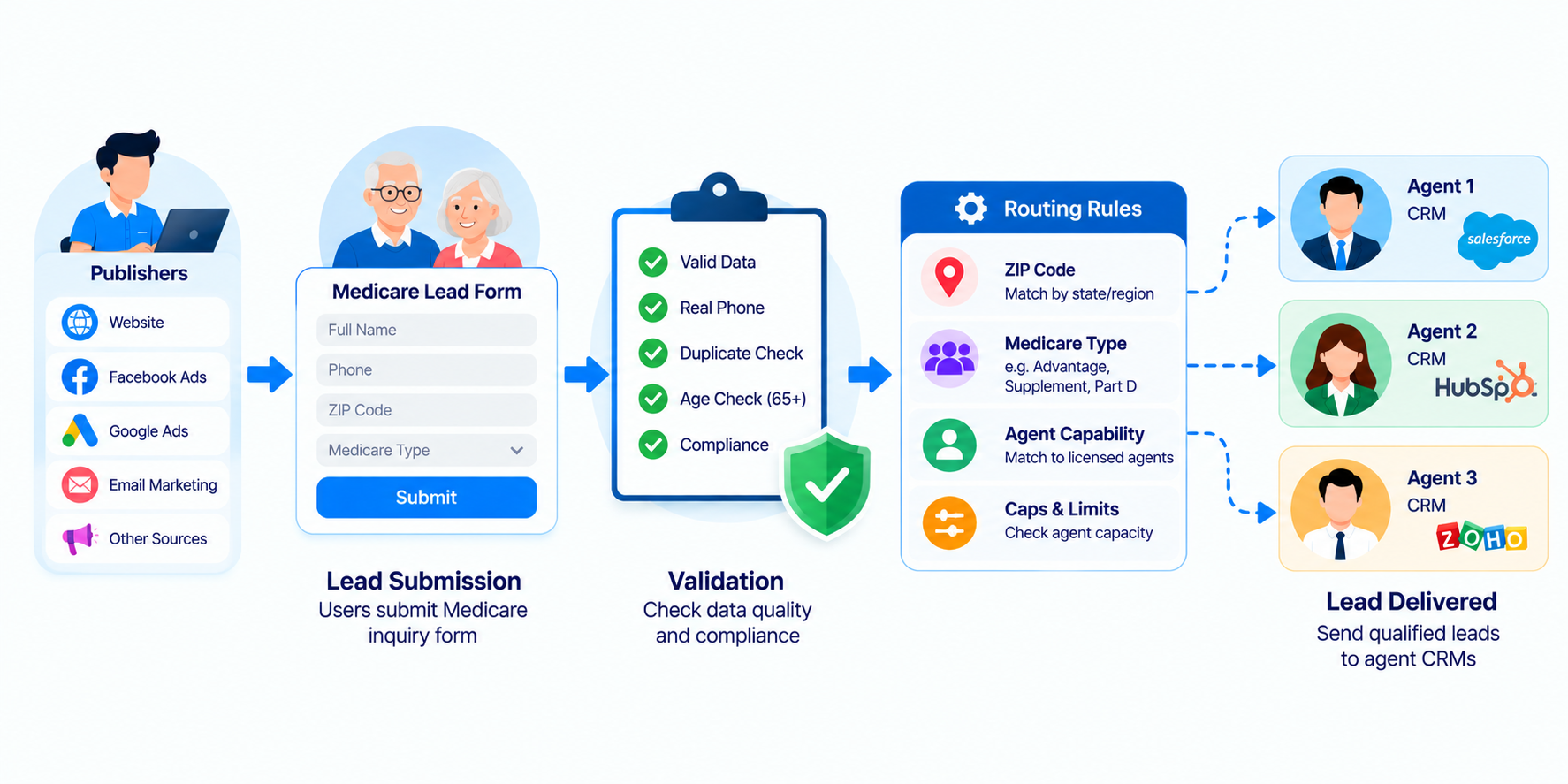
One platform connects sources, rules and buyers.
Compliance: The Part You Cannot Skip
Medicare marketing is more regulated than most insurance categories. The Centers for Medicare & Medicaid Services sets marketing and communication rules for plan sellers, including requirements that affect third-party marketing organizations, disclaimers and call handling. On top of that, federal telemarketing law and state insurance departments add their own requirements for consent, calling hours and agent licensing.
A platform cannot make you compliant by itself, but it makes compliance far easier. Stored consent records, time-zone-aware calling schedules, license-based routing and clear audit trails turn what would be a manual burden into a built-in habit.
What This Looks Like During Annual Enrollment
It is the second week of October. A 67-year-old in Arizona clicks an ad and requests a Medicare Advantage quote at 9:40 on a Tuesday morning. Within a second or two the platform validates her number, confirms consent and finds three buyers who are licensed in Arizona and are accepting Advantage leads under their daily caps.
One buyer has already hit its cap and is skipped. The other two return prices, and the higher bidder receives the full lead in its CRM along with a text alert. The agent calls within minutes, while she is still looking at plan information. Had the lead gone through a manual process, it might have reached an agent in the afternoon, long after she had spoken to someone else.
How to Choose the Right Platform
When you evaluate vendors, test them against real traffic and real rules rather than a demo script. The table below shows how a basic setup compares with a platform that is ready for peak Medicare season.
| Capability | Basic Setup | Season-Ready Platform |
|---|---|---|
| Delivery speed | Email or batch files | Real-time API, CRM and dialer delivery |
| Consent tracking | Manual or missing | Automatic records stored per lead |
| Routing | Rotation or manual forwarding | State, license, plan-type and cap-based rules |
| Pricing | Fixed flat rate | Bidding and priority tiers |
| Reporting | Spreadsheets after the fact | Live dashboards by source, buyer and plan type |
| Peak handling | Slows under volume | Built for enrollment-season spikes |
Also look at pricing, onboarding help and support response times, because you will need all of them in October. After launch, review contact rate, speed to contact, return rate, cost per enrollment and revenue per lead each week, split by source and buyer so problems are easy to spot.
Conclusion: Build Before the Rush
Medicare lead distribution is about doing a few things consistently well: capturing clean data, recording consent, matching leads to the right licensed buyers and delivering them quickly. The platforms that do this reliably give publishers better prices, give agents better conversations and give compliance teams the records they need. If you are preparing for enrollment season, the best time to test your Ping Tree System setup is before the leads start to flood in.
Ready to prepare for Medicare season? Explore our Medicare Leads solution or request a free demo →
Frequently Asked Questions
It is software that receives Medicare prospect inquiries, validates them, applies routing rules and delivers each lead to the agent, agency or carrier that best matches it, often in real time.
The form data enters the platform, which verifies contact details and consent, checks buyer filters such as state, license and plan type, runs a bid or priority order, and then delivers the lead to the winning agent by API, CRM, dialer or alert.
The Annual Enrollment Period, which runs from October 15 to December 7 each year, is the busiest season. Volume also rises around the Medicare Advantage Open Enrollment Period from January 1 to March 31 and for people turning 65.
Agents and marketing organizations must follow CMS marketing rules, TCPA and state insurance requirements, including valid consent and required disclosures. Rules change, so verify current requirements with CMS and qualified legal counsel.
Look for real-time delivery, consent tracking, state and license filters, plan-type routing, caps and schedules, CRM and dialer integrations, clear reporting and responsive support.
Yes. The platform supports real-time ping post, state and plan-type filters, bidding, tiered routing, caps, schedules and reporting. You can learn more or book a demo at pingtreesystems.com/contact.